What “Nationwide” Actually Means When You Ship a Car
Roughly a hundred thousand vehicles move between American states every week on car haulers, sold to consumers under a phrase that sounds simple and is not: nationwide service. The phrase describes a commercial promise rather than a physical fleet, and understanding the difference explains most of what confuses people about auto transport, including why two quotes for the same distance can land far apart.
Nationwide coverage describes a network, not a garage full of trucks
Very few companies advertising service across the lower 48 operate trucks in all of them. The trucking side of this industry is highly fragmented. Most car haulers are small operations running a limited set of lanes with a handful of trailers.
National coverage is therefore assembled rather than owned. An auto transport broker holds federal brokerage authority, takes the booking, and assigns the shipment to a licensed motor carrier whose route matches. The broker coordinates. The carrier drives. Both must be registered with the Federal Motor Carrier Safety Administration, but their obligations are not the same. The carrier physically possesses the vehicle and is the party whose cargo insurance responds to a damage claim. The broker arranges the match and, under federal financial responsibility rules, must maintain a surety bond or trust fund of $75,000.
That structure is what allows a nationwide car shipping company to quote a route from rural Montana to coastal Georgia without owning a truck in either state. It also explains something that surprises first-time customers more than anything else in the process: the name on the booking confirmation and the name on the trailer are frequently different, and that is normal rather than a warning sign.
Route density explains more about your quote than mileage does
Carrier availability is not evenly distributed. Heavily traveled corridors between large metros support constant traffic in both directions, so a truck can fill a trailer, deliver, and reload without deadheading. Thinner lanes do not offer that. A pickup forty miles off an interstate in a low-population county may require a driver to spend two hours retrieving one car, and that inefficiency has to be priced somewhere.
The practical effect shows up in two places, not one. Price is the obvious one. Speed is the one people overlook. On a dense lane, a shipment might be assigned to a carrier within a day or two. On a thin lane, the booking may sit while a broker waits for a truck to schedule that direction. A quote that looks competitive can still come with a pickup window measured in weeks if the route rarely sees traffic.
Distance behaves less intuitively than most people expect. Total price generally rises with mileage, but the per-mile figure usually falls, because fixed costs at pickup and delivery are spread across more miles. Industry rate data published for 2026 illustrates the spread: one national auto transport operator reported a median open-carrier rate of about $1.23 per mile at a median shipment distance near 987 miles, with observed rates ranging from roughly $0.33 to $2.00 per mile depending on the shipment.
Short interstate hops frequently price above a dollar per mile, while long coast-to-coast runs can settle well below that. Freight market reporting for 2026 put open transport for an operable sedan across the country in a range of roughly $1,100 to $1,700. These are observed ranges, not rate cards. A quote is a price offered for defined service, and only a booked and accepted load is a confirmed price.
Open, enclosed, and the honest version of door-to-door
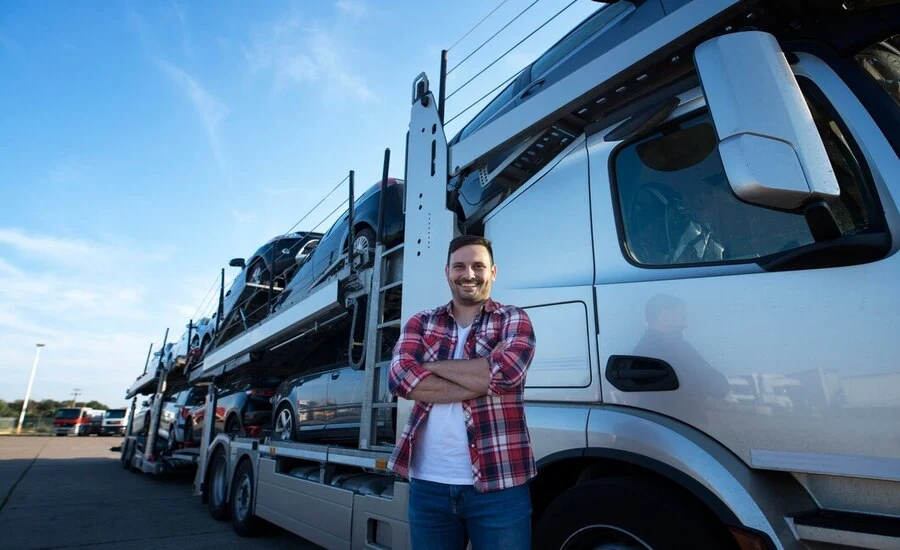
Open transport moves the large majority of vehicles. The car rides on a multi-level trailer exposed to weather and road spray, which is the same exposure it experiences parked outside. Capacity is high, availability is broad, and cost is lower.
Enclosed transport puts the vehicle inside a covered trailer. Those trailers carry fewer cars, cost more to operate, and exist in smaller numbers, so the premium is real and varies by lane. Enclosed makes clear sense for a low-clearance car that cannot use standard ramps, for original or freshly restored paint, and for vehicles whose value makes a rock chip a financial event. It is not automatically required simply because a car is expensive.
Door-to-door deserves plain language. A loaded car hauler can approach 75 feet long and 13 feet tall. It cannot legally or physically navigate many residential streets, low branches, gated communities, tight apartment complexes, or downtown blocks with truck restrictions. Door-to-door in practice means the driver gets as close as conditions allow and, where direct access is impractical, arranges a nearby accessible meeting point such as a large retail lot. This is standard operating reality, not a reduction in service, and knowing it in advance prevents an unpleasant phone call on delivery day.
Legitimacy and reputation are two separate checks
These get conflated constantly, and they measure different things.
Legitimacy is regulatory. Any company arranging or performing interstate transport must hold active operating authority, and anyone can verify this without cost through the FMCSA SAFER system, searching by company name, USDOT number, or MC number. Confirm that the authority is active, that the entity type matches what the company described, and that insurance is on file.
Reputation is behavioral, and reviews speak to it, but a strong rating proves nothing about authorization. Complaint volume in this sector is not trivial. FMCSA reported that filings to its national consumer complaint database rose from 4,340 in 2020 to 8,295 in 2021.
Two additional habits protect a shipment. Compare quotes only at matching service levels, meaning open against open with a similar pickup window, since a cheaper number often describes a different product. And treat the Bill of Lading as the document that matters: it records vehicle condition at pickup, and inspecting the car and noting any new damage before signing at delivery is what preserves a claim.
Nationwide service is a coordination achievement rather than a fleet. Judged that way, the right questions become obvious: who is actually driving, how busy is this route, and what exactly does the quoted price cover.